

Bolted Rail Joint Designs
In order to prevent loosening of bolted rail joint, various techniques are recommended and employed to maintain clamping force in the joint. Some of these techniques are the parameters used by Rail Joint designers during the design process and these include:
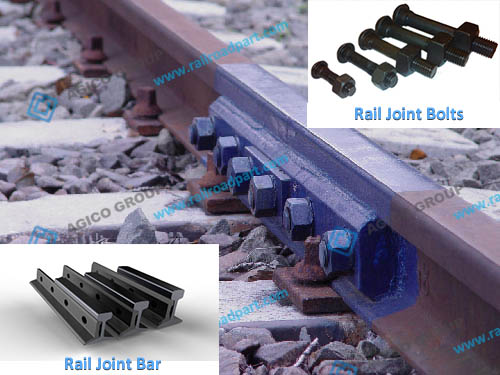
- Material selection by the designer to enhance friction between the clamped surfaces.
- Matching of materials at the joint to guarantee sufficient clamping force at varying service temperatures.
- Design of mating material components with minimal clearance.
- Design of joint for high preload application (this improves friction between the contacting surfaces of the bolted joint thereby increasing vibration induced loosening resistance).
Is it Possible to Manufacture a Perfect Rail Joint with Bolts
In theory, it is possible to design a joint that will retain a sufficient prevailing (residual) torque to overcome the service load without rotational loosening even in the absence of any locking device. However, in practice, bolted joints do turn loose. Furthermore, a detailed procedure for the design of bolted joint of this nature requires full information of all forces on the joint and, most times, such knowledge is not available. Hence, designers commonly specify the use of a fastener locking device on the fastener in a joint during installation to prevent loosening. Fastener locking methods such as an adhesive thread-locking liquid chemicals such as ‘Loctite’ and ‘Precote’, prevailing torque locking nuts, cotter pin and castle nut, multiple bolts locked together using safety-wires, restraining plates, ratcheted washers, modified threaded fasteners (bolt and nut) and use of two nuts are usually employed.
The success of these fastening methods depends on the amount of the bolt pre-load that can be maintained for a given vibration cycle. The majority of the locking devices do not totally lock the fastener, but tolerate some degree of self-loosening under dynamic shear loading.
Present Researches on Railway Joint and Bolts
Investigations of Contact Pressure Distribution in Rail Bolted Joints. Bolted rail joints have been a focus of many investigations, many of these studies involved analytical and numerical models to predict the contact pressure distribution in the interface of bolted joints. Some other researchers have used experimental approaches in their investigations to know the geometry and the magnitude of the contact pressure in the clamped interface of bolted joints. Some of the studies carried out using these methods are discussed in the following sections.


