


CWR has its beneifts, but comes with its own set of headaches in return.
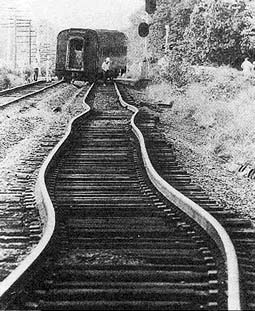
When using a rail joint in track that is not Continusly Welded Rail (CWR). For a repair or new joint, if you can do a field weld cheaper than drilling two (minimum) holes and installing the fish plates and bolts, that would be acceptable. Just keep in mind that creating long stretches of welded rail can lead to "sun kinks" as shown above if the track structure can't restrain the expansion.
Continous Welded Rail Application in Indian
Indian Railways have many factories spread out at number of places like Mumbai,Meerut, Secunderabad etc. where they have Rail Welding factories. Rails are butt welded up to 100 mts length. There are special machines for such job and special wagons and cranes which handle such long rails.
Steel Rails are welded so as to reduce the noise in the running trains, but after each 100 mts fish plate joints are provided for lateral expansion of the rails during hot summers.
Reducing the number of fishplate joints also saves wear on the tires on the wheels. tire maintencnce is an expensive process as the axles have to be removed and sent to a shop with special machine to cut and grind the wheels.It has been seen at some place in South India. At the fishplate joint section which is I believe after 10 welded rail sections, there is a gap that takes care of the lateral expansion that occurs when a train moves on the rails and they get warmer and expand.
Requirements when using continuous long welded rails
Continuous, long-welded rails [CWR] require more rigorous engineering practices than rails with fishplate joint method.
- The rail must be stiffer
- The sleepers or other carrying devices must be heavier
- The ballast must be more plentiful
- The rail fastenings must be suitable
- The rail must be stretched, usually, when laid (many operations take place overnight) so as to be at a neutral stress point when temperatures rise
- "Breather switches" are usually provided where CWR adjoins fishplate-jointed track.
- Mechanised track installation and maintenance becomes the norm
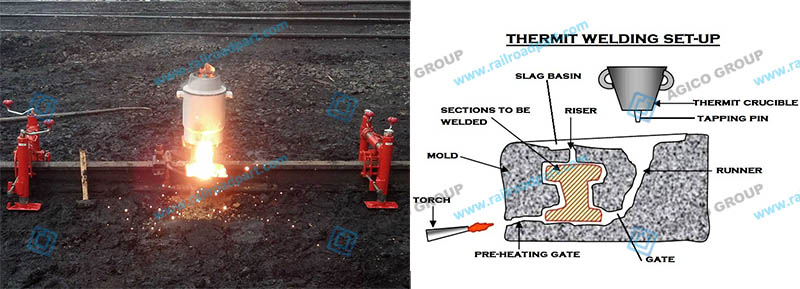
To reduce site welds, strings of CWR are made-up in factories by the flash butt-weld process, introducing site delivery complications, and the strings welded at site using the Thermite process. Seamless Rail Track reduces the requirement for service interruptions for maintenance compared with fishplated track, and reduces the need for maintenance on vehicles, as others have indicated above.
Comparion of Fishplate and welded Joint Methods in Application
Rail track with fishplate and bolts is therefore more suited to places where traffic is lighter, and manual, heritage, maintenance practices are the norm. Most national rail service providers, where speeds are high and traffic is heavy, will provide CWR where possible and economic. The UK's National Rail Track Design Handbook gives examples where fishplated track may be installed new and where CWR should be installed new, so national standards are the best source of information.
Due care must be exercised when forming holes for fishplate bolts to reduce the risk of rail-end breakages from stress cracks. Periodically, the joint must be disassembled for routine inspection and lubrication, which cannot usually be done under traffic.
Other operators have different standards: London Underground, Coras Iompar Eirann (Irish Rail) and various heritage rail operators, for example, will have different applications for CWR versus fishplated track for sound practical and economic reasons, and the balance point between the two types will be different for each one.


